
Thursday, October 21, 2010
Pakistan Relief
The most common poster theme that I see around town is related to the floods that have occurred in Pakistan. Plenty of Turkish relief groups seem involved in trying to give money and assistance to those who have suffered in Pakistan.
 This poster is outside of the Blue Mosque. The man in the picture is holding his prayer carpet, presumably the only item that he was able to save from the flood. Such an image would especially appeal to people on their way to pray at the Mosque.

Cats of Istanbul
A surprising discovery that I made on my first day of arrival was the amazing number of cats running around Istanbul. Most of these cats are quite friendly, not the nervous stray cats that I would expect.

This cat I saw next to these ruins near my hotel. Who knows when this old wall was built.

I saw this relatively scary poster up near the Blue Mosque. I don't know what it says, but I think that it is a public service announcement about stray cats.

This cat I saw next to these ruins near my hotel. Who knows when this old wall was built.

I saw this relatively scary poster up near the Blue Mosque. I don't know what it says, but I think that it is a public service announcement about stray cats.
Book Burning and Eunuchs
At the refreshment table after the symposium today, I met a college professor from New England who is presenting on Saturday. He is a specialist in ancient book burning. He follows different movements in ancient Greece, Rome and Constantinople that promoted book burning. Just talking with him about his research was fascinating. Of course, book burning was a stronger act back when all books were laboriously written by hand. He also mentioned that books that were a target of book burning tended to be saved better than others because people would hide them. Years or even centuries later they were found and saved.
We took the shuttle bus home and had a great time talking with a couple of other people. He was describing his earlier research. He was a specialist in eunuchs in different civilizations, including ancient Greece. After attending a few conferences when people would come up to him and say, "hey, you're that eunuch guy, right?" he decided to change his area of specialty. If you don't know what a eunuch is, I'll let you look that definition up on your own...
After leaving the book-burning eunuch guy, I walked the streets of Istanbul. This is a vibrant city with loads of young people everywhere.
We took the shuttle bus home and had a great time talking with a couple of other people. He was describing his earlier research. He was a specialist in eunuchs in different civilizations, including ancient Greece. After attending a few conferences when people would come up to him and say, "hey, you're that eunuch guy, right?" he decided to change his area of specialty. If you don't know what a eunuch is, I'll let you look that definition up on your own...
After leaving the book-burning eunuch guy, I walked the streets of Istanbul. This is a vibrant city with loads of young people everywhere.
Start of the symposium
After about a day and a half of getting to know the old city of Istanbul, my scholarly symposium started this afternoon. The opening was in a newer part of town in a concert hall, much like the Van Wezel in Sarasota.

In addition to the opening remarks were a set of talks by noted professors on the issue of Civilization and World History. One of the four presenters is a really well known scholar who has written one of the main textbooks for college world history. His talk was really off topic, dealing more with how we should divide history into different periods of time than the way we do it now.
The other three essentially said that Byzantine and Ottoman history have both been neglected in scholarship for a long, long time. For a variety of political reasons and just a more western-focused attitude in universities, these empires have been ignored by most world historians. One said that a gathering that he put together on Ottoman history some years ago was actively protested by Turkish students who didn't want to look backwards. Their nationalism was forward looking.
Another professor mentioned that now that tourism is such a massive industry, pro-Ottoman feelings may be swinging too far in the other direction. Politics are involved because the countries that made up the old Ottoman Empire tend to be disfunctional: Bosnia, Iraq, Libya, Serbia, etc. A "new Ottomanism" has become popular in which Turkey becomes a dominate regional leader separate from the rest of Europe.
Yes, history can be used as a tool of power.
The very last statement at the end of the three hour event was from a professor who wants to see a Byzantine/Ottoman Commonwealth Games, in which all of the countries that were formerly part of either empire come together for sporting competitions.
That's a cool idea.

In addition to the opening remarks were a set of talks by noted professors on the issue of Civilization and World History. One of the four presenters is a really well known scholar who has written one of the main textbooks for college world history. His talk was really off topic, dealing more with how we should divide history into different periods of time than the way we do it now.
The other three essentially said that Byzantine and Ottoman history have both been neglected in scholarship for a long, long time. For a variety of political reasons and just a more western-focused attitude in universities, these empires have been ignored by most world historians. One said that a gathering that he put together on Ottoman history some years ago was actively protested by Turkish students who didn't want to look backwards. Their nationalism was forward looking.
Another professor mentioned that now that tourism is such a massive industry, pro-Ottoman feelings may be swinging too far in the other direction. Politics are involved because the countries that made up the old Ottoman Empire tend to be disfunctional: Bosnia, Iraq, Libya, Serbia, etc. A "new Ottomanism" has become popular in which Turkey becomes a dominate regional leader separate from the rest of Europe.
Yes, history can be used as a tool of power.
The very last statement at the end of the three hour event was from a professor who wants to see a Byzantine/Ottoman Commonwealth Games, in which all of the countries that were formerly part of either empire come together for sporting competitions.
That's a cool idea.
Wednesday, October 20, 2010
Blue Mosque
After lunch at the Cok house, Recep walked me over to the Blue Mosque. This building is the largest, most distinctive structure on the Istanbul skyline. Its six minarets rise up while the vast dome pushes out with a series of 21 half domes and secondary domes.
The architect was a student of Sinan. In this case the student seemed to have learned his lesson well.
Right across from the Blue Mosque is a park, really a part of the old hippodrome that the Byzantines used to race horses. With gladiatorial contests frowned upon in the Christian Byzantine Empire, horse racing was the best pastime. But now the horses, track, and spectator seating is gone. Instead is a lovely park separating the Blue Mosque from its architectural forefather, Hagia Sophia.
Upon entering the mosque gate, a young man offered me a free tour. He tried to get me in a side door where the local worshiper line up. Rebuffed harshly by the guard, he followed me to the back where tourists were queued up to go inside. It shouldn't be a surprise to those who have read an earlier post to know that this man was a carpet salesman interested in hooking me in for a post-tour visit to his shop. I pushed him away with the idea that I under no circumstances purchase a carpet today.3
Instead of a free tour, I got a tour by an older man who worked at the mosque. I took off my shoes, placed them in a plastic baggie, and passed by a group of women tourists who were awkwardly trying to put on the headscarves required before entering.
My tour guide narrated the simple story of the Blue Mosque. Built by Sultan Ahmed in just seven years in the 1600s, the mosque gets its name from the glorious tiles inside. The space inside is expansive. The vaulted ceiling rises up gloriously on a series of half domes and four columns covered in marble.
Tourists are restricted to the back, while people who are worshiping can cross over a small rail (looks like a chancel rail in a church) to approach the side that faces Mecca. My guide, with some degree of authority, led me past the rail so that I could see up close the architectural detail of the qiblah wall and the mibrah niche.

The mibrah in the Blue Mosque is special since it has a small piece of the black meteorite stone from the Ka'aba in Mecca. Seriously. I guess that since all of the Ottoman sultans were also the caretakers of the holy sites in Arabia, they could take what they wanted. I got a close look.

[In the center of this mibrah is a small five-sided black stone. That is the piece of the Ka'aba meteorite.]
Other than the dazzling tile work and vaulted domes, the most interesting parts were the ornamented stairway and chair where the imam gives his sermons. In the Blue Mosque it is covered in gold leaf.

I was also allowed to inspect the chair that apparently Sultan Ahmed constructed with his own hand. A fine piece of workmanship, it had elaborate carvings and inlays of mother of pearl. I had heard before that each sultan had to take up a craft. Sulieyman, for example, was known for his gold work. I wonder how the sultan could rule his vast empire given the various distractions of court life, the harem, and his required craft.
I could not quite figure out my guide. Although knowledgeable about the site and quite willing to tailor the presentation to suit a world history teacher, he didn't strike me as altogether authentic. The only official actions that he took on my tour that made him seem as an employee of the mosque were the occasions that he shooed away women from coming forward past the railing. The women seemed like pious Muslims there for prayer. Women, he mentioned, mainly come to this mosque during Ramadan. Then they open up a balcony for them that is quite out of sight of the men.
I paid him well for his guide services, which I now had guessed were freelancing, preferable by far to a carpet salesman. Did I actually have any authority to walk where I did in the holiest parts of the Blue Mosque? I'm not sure, but I did get a close up look at some stunningly beautiful religious furnishings.
The architect was a student of Sinan. In this case the student seemed to have learned his lesson well.
Right across from the Blue Mosque is a park, really a part of the old hippodrome that the Byzantines used to race horses. With gladiatorial contests frowned upon in the Christian Byzantine Empire, horse racing was the best pastime. But now the horses, track, and spectator seating is gone. Instead is a lovely park separating the Blue Mosque from its architectural forefather, Hagia Sophia.
Upon entering the mosque gate, a young man offered me a free tour. He tried to get me in a side door where the local worshiper line up. Rebuffed harshly by the guard, he followed me to the back where tourists were queued up to go inside. It shouldn't be a surprise to those who have read an earlier post to know that this man was a carpet salesman interested in hooking me in for a post-tour visit to his shop. I pushed him away with the idea that I under no circumstances purchase a carpet today.3
Instead of a free tour, I got a tour by an older man who worked at the mosque. I took off my shoes, placed them in a plastic baggie, and passed by a group of women tourists who were awkwardly trying to put on the headscarves required before entering.
My tour guide narrated the simple story of the Blue Mosque. Built by Sultan Ahmed in just seven years in the 1600s, the mosque gets its name from the glorious tiles inside. The space inside is expansive. The vaulted ceiling rises up gloriously on a series of half domes and four columns covered in marble.
Tourists are restricted to the back, while people who are worshiping can cross over a small rail (looks like a chancel rail in a church) to approach the side that faces Mecca. My guide, with some degree of authority, led me past the rail so that I could see up close the architectural detail of the qiblah wall and the mibrah niche.

The mibrah in the Blue Mosque is special since it has a small piece of the black meteorite stone from the Ka'aba in Mecca. Seriously. I guess that since all of the Ottoman sultans were also the caretakers of the holy sites in Arabia, they could take what they wanted. I got a close look.

[In the center of this mibrah is a small five-sided black stone. That is the piece of the Ka'aba meteorite.]
Other than the dazzling tile work and vaulted domes, the most interesting parts were the ornamented stairway and chair where the imam gives his sermons. In the Blue Mosque it is covered in gold leaf.

I was also allowed to inspect the chair that apparently Sultan Ahmed constructed with his own hand. A fine piece of workmanship, it had elaborate carvings and inlays of mother of pearl. I had heard before that each sultan had to take up a craft. Sulieyman, for example, was known for his gold work. I wonder how the sultan could rule his vast empire given the various distractions of court life, the harem, and his required craft.
I could not quite figure out my guide. Although knowledgeable about the site and quite willing to tailor the presentation to suit a world history teacher, he didn't strike me as altogether authentic. The only official actions that he took on my tour that made him seem as an employee of the mosque were the occasions that he shooed away women from coming forward past the railing. The women seemed like pious Muslims there for prayer. Women, he mentioned, mainly come to this mosque during Ramadan. Then they open up a balcony for them that is quite out of sight of the men.
I paid him well for his guide services, which I now had guessed were freelancing, preferable by far to a carpet salesman. Did I actually have any authority to walk where I did in the holiest parts of the Blue Mosque? I'm not sure, but I did get a close up look at some stunningly beautiful religious furnishings.
Byzantine Cistern
When I spoke to Recep back in May about my sightseeing plans for Istanbul, he mentioned that I must see the ancient Byzantine cistern. Beautiful, he said. So, as I was walking to his place this afternoon, I saw the entrance to the cistern with tour buses in front. I paid the 6 euros and took a long stairway down below the rest of the city.
Modern Istanbul is built on old Istanbul, which was built on old Constantinople, which was before even older Roman Byzantium. Layers and layers of history. On a side note, I heard that a new subway line is being built. It has run into delays, however, because the subway stop closest to the tourist district turned out to be a major Byzantine archeological site. Apparently they found a full Byzantine ship.
The cistern that I saw was vast. The major attraction to the site is the organized rows and rows of columns that support the roof of the cistern, which is in turn supporting the buildings on top. The cistern itself was built during the major renovations to Constantinople done by Justinian and Theodora in the 500s AD. Obviously they had recycled columns that were associated with other sites. The columns were a hodgepodge of different styles. Two of the hundreds of columns had bases with Medusa heads.

Seeing the cistern was like visiting a Roman temple dedicated to water storage.
In a completely non-Istanbul fact, I grew up in Sarasota at a house that had a vast underground cistern. The cistern actually was featured in an article last year in the Sarasota Herald Tribune. I would hesitate sending tourists to see it though. The snakes found in the Whelan cistern may not limited to those carved into Medusa-headed column bases.
I found out later that the Ottoman Historical Archives, which is located directly across the street from the Cok house and carpet store, will be razed soon because the weight is too much for the cistern columns underneath to support.
Modern Istanbul is built on old Istanbul, which was built on old Constantinople, which was before even older Roman Byzantium. Layers and layers of history. On a side note, I heard that a new subway line is being built. It has run into delays, however, because the subway stop closest to the tourist district turned out to be a major Byzantine archeological site. Apparently they found a full Byzantine ship.
The cistern that I saw was vast. The major attraction to the site is the organized rows and rows of columns that support the roof of the cistern, which is in turn supporting the buildings on top. The cistern itself was built during the major renovations to Constantinople done by Justinian and Theodora in the 500s AD. Obviously they had recycled columns that were associated with other sites. The columns were a hodgepodge of different styles. Two of the hundreds of columns had bases with Medusa heads.

Seeing the cistern was like visiting a Roman temple dedicated to water storage.
In a completely non-Istanbul fact, I grew up in Sarasota at a house that had a vast underground cistern. The cistern actually was featured in an article last year in the Sarasota Herald Tribune. I would hesitate sending tourists to see it though. The snakes found in the Whelan cistern may not limited to those carved into Medusa-headed column bases.
I found out later that the Ottoman Historical Archives, which is located directly across the street from the Cok house and carpet store, will be razed soon because the weight is too much for the cistern columns underneath to support.
Turkish Carpets
Istanpul has thousands of mosques, but it must have tens of thousands of carpet salesmen. Walking down the street, even with the "after" dressing look mentioned in an earlier post, I was a target of a number of people who wanted me to visit their carpet shops. Never did I say that I wanted to buy carpet, but even still many kept with a good pitch.
A typical encounter would have the person offering me directions, help, or asking about where I am from. Despite news reports to the contrary, Turks love America and all things American. Mind you the sample size for this opinion study is self-reporting carpet salesmen in Istanbul trying to lure Americans in to their stores.
 Twice I entered stores and was exposed to the hard sale. In one instance I was offered apple tea and just a few minutes later a full lunch with lamb and rice. I learned a great deal about carpets and this man's life, although upon reflection, I don't know how much of what he said was really true. For example, many of the carpets looked like they were made with chemical dyes. He said all were natural dyes. In another example, he said that a smaller piece could be thrown into the washing machine. Yeah, right.
 [This is a picture of Sahir on the left and his father. They are eating a pomegranate. Sahir is a carpet salesman who tried valiantly to sell me a carpet. Essentially he tried to ply me with food: pomegranate, apple tea, and lamb.]
In the end I found the street where the Cok family lives in Istanbul. When Oliver's dad Recep visited school back in May, he invited me to visit his place. The street is right near the major mosques and tourist attractions of the city. As I was walking down the street, a young man who works for Recep yelled out, "Patrick, Patrick." Apparently they had been expecting me to come this week and were on the lookout.
The Cok's business? Well carpets of course. I was great after a long afternoon to be treated as a friend from someone who really is a friend with a common bond. More apple tea, more offered food, no selling at all. Pictures of Oliver are all around the place. I received good reports about Oliver's experience at The George Washington University in Washington DC. We set a meal date for Friday evening.
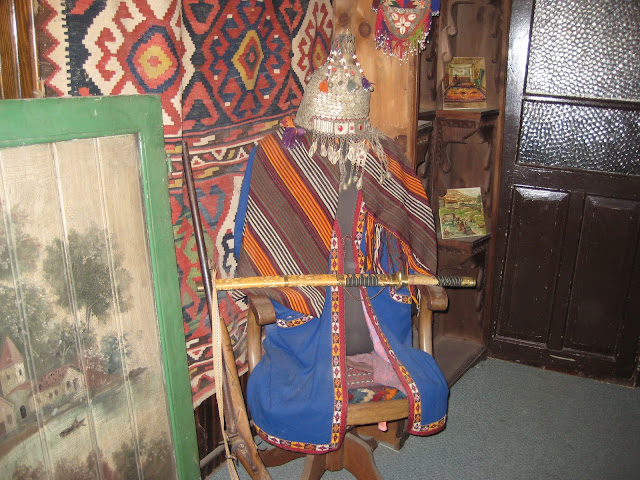 A central Asian costume inside the Cok store.
A typical encounter would have the person offering me directions, help, or asking about where I am from. Despite news reports to the contrary, Turks love America and all things American. Mind you the sample size for this opinion study is self-reporting carpet salesmen in Istanbul trying to lure Americans in to their stores.


In the end I found the street where the Cok family lives in Istanbul. When Oliver's dad Recep visited school back in May, he invited me to visit his place. The street is right near the major mosques and tourist attractions of the city. As I was walking down the street, a young man who works for Recep yelled out, "Patrick, Patrick." Apparently they had been expecting me to come this week and were on the lookout.
The Cok's business? Well carpets of course. I was great after a long afternoon to be treated as a friend from someone who really is a friend with a common bond. More apple tea, more offered food, no selling at all. Pictures of Oliver are all around the place. I received good reports about Oliver's experience at The George Washington University in Washington DC. We set a meal date for Friday evening.

Subscribe to:
Posts (Atom)